
Training science for hybrid racing
Analyse your cadence, train with precision and reach your best self
Hybrid Flow turns two well-studied signals, movement rhythm and heart rate, into a training method: a metronome for every block, an incremental test that finds your most economical cadence, and a round-by-round picture of where fatigue costs you.


iPhone · iPad · Apple Watch · Android · Wear OS · Free to start
The demands of the race
Why rhythm and heart rate
Running economy and the cost of each station decide the result. Both can be measured, and both respond to training.12
The method
Pace it. Test it. Measure it.
Four tools that work together: set a rhythm, find the right one for you, see how it holds under fatigue and train without looking at a screen.
Pace
An audio metronome with its own cadence for every block of a session.
Test
An incremental protocol that finds the cadence with the lowest heart rate at a fixed load.
Measure
Heart rate, drop-off and heart-rate economy per block and per round.
Focus
Voice cues, an optional 40 Hz binaural layer and the whole session on your wrist.
01 · Auditory-motor synchronisation
A metronome for every block
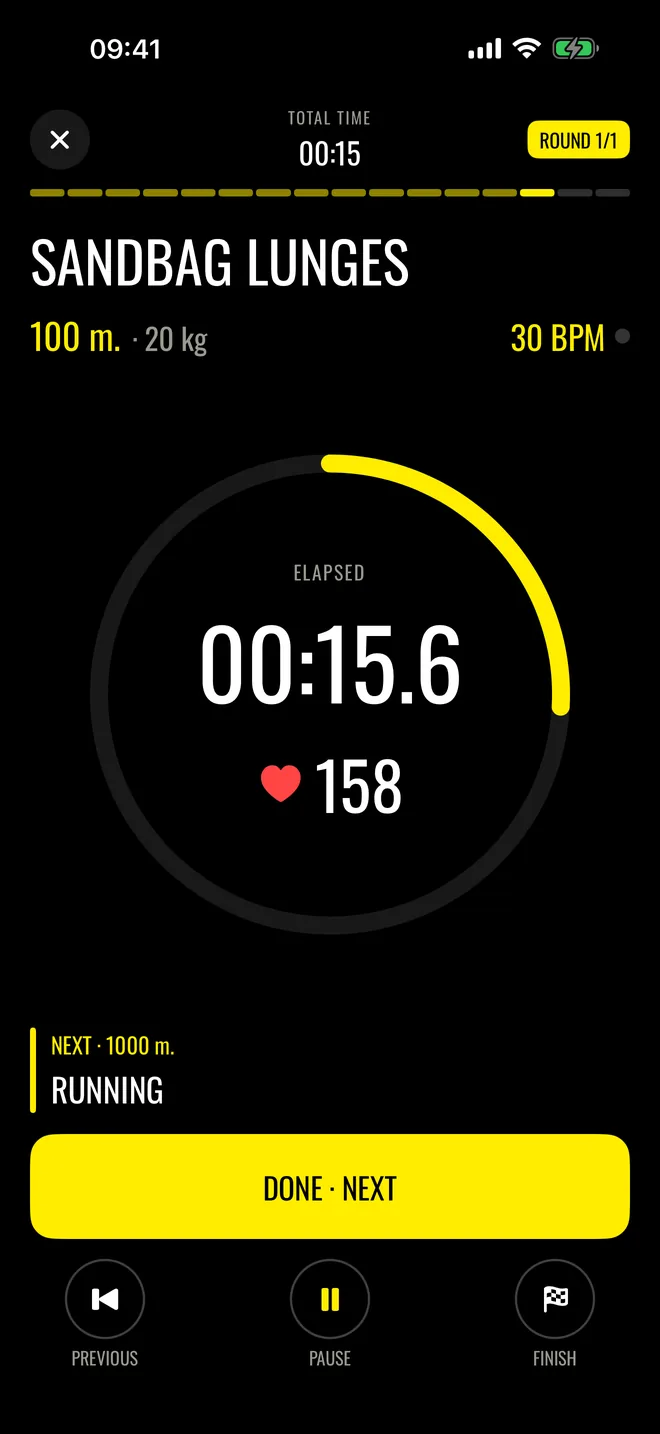
Movement locks on to an external beat with remarkable precision. Hybrid Flow gives every block of a session its own cadence: runs, ergs, wall balls, sleds and rests. The beat keeps going with the screen locked and your music playing.
Runners spontaneously synchronise their step rate to an auditory beat. Synchronised rhythm can lower perceived exertion and, in some studies, the energy cost of movement. The benefit depends on matching the beat to the athlete and the task, so each block has its own cadence instead of one tempo for the whole session.
- Cadence, goal (time, distance or reps) and load per block, up to 99 rounds
- Voice cues for the next exercise, a halfway alert and configurable transitions
- Templates with the official HYROX weights for each division
02 · The individual optimum
Find your most economical cadence
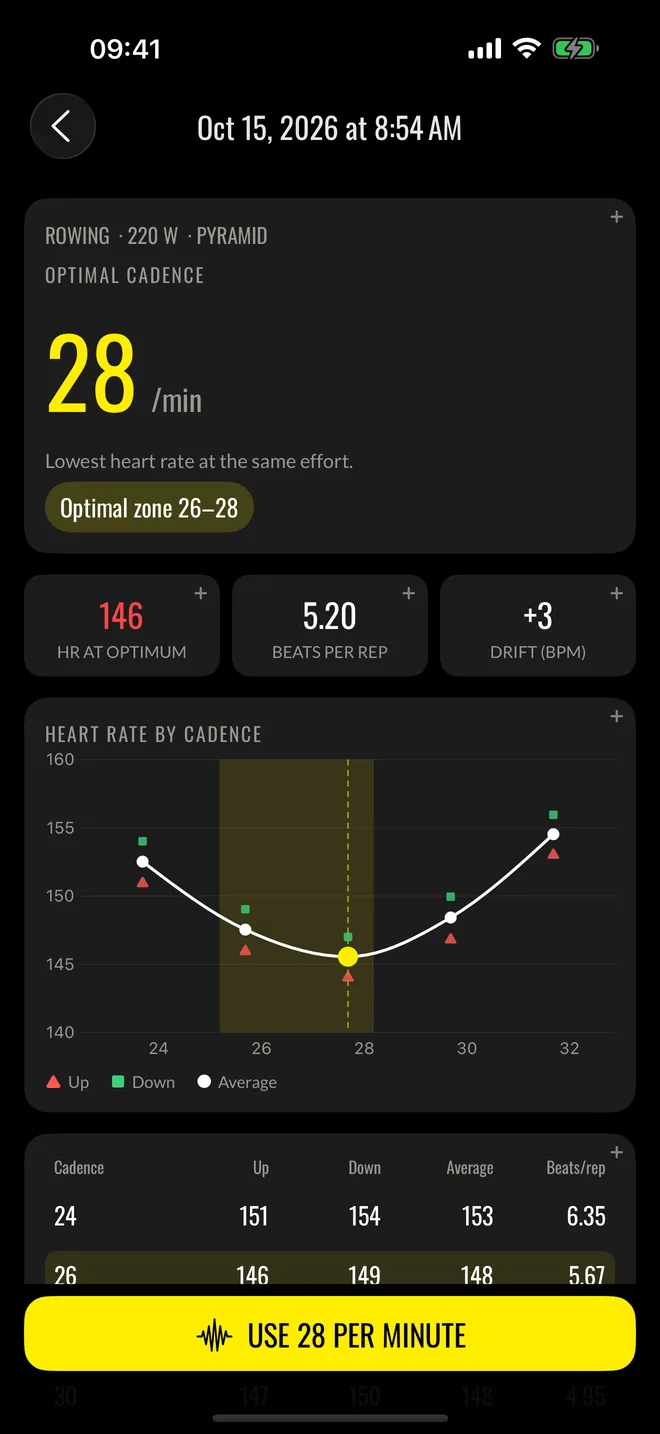
There is no universal ideal cadence. Preferred stride and stroke rates are individual, and they shift with fatigue. The incremental cadence test measures yours: stages at a fixed effort, each at a different cadence set by the metronome, with heart rate recorded throughout.
At a constant external load, the cadence that needs the lowest steady-state heart rate is the one your cardiovascular system finds cheapest. Running economy research describes the same U-shaped relation between step rate and oxygen cost: most runners sit close to their optimum, but not always at it, and fatigue moves it.
- Steady-state heart rate per stage, taken from the last 30 s once the response has settled
- Pyramid protocol: the rising and falling legs are averaged to cancel cardiac drift, and the drift is reported
- Optimal zone: every cadence within 2 bpm of the best. Without a fixed load, heartbeats per rep decide.
The protocol
- 1
Fix the load
Choose the exercise and a constant external effort: watts, pace per 500 m or treadmill speed. Or set none, to compare heartbeats per rep.
- 2
Follow the stages
The metronome sets each cadence, one to three minutes per stage, as a ramp, a pyramid or an inverted pyramid.
- 3
Read the curve
Heart rate against cadence, the optimal zone and the drift between legs. One tap turns the result into your metronome.
03 · Heart-rate economy and fatigue
See exactly where you lose pace
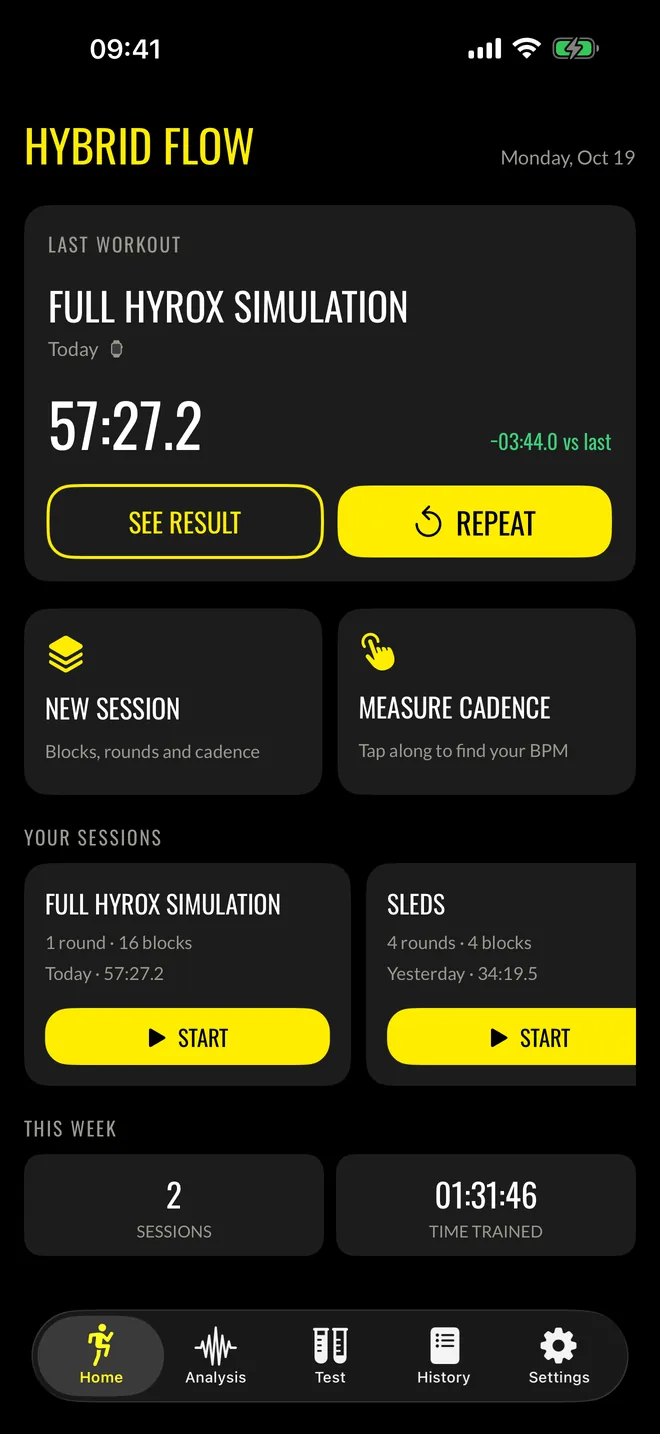
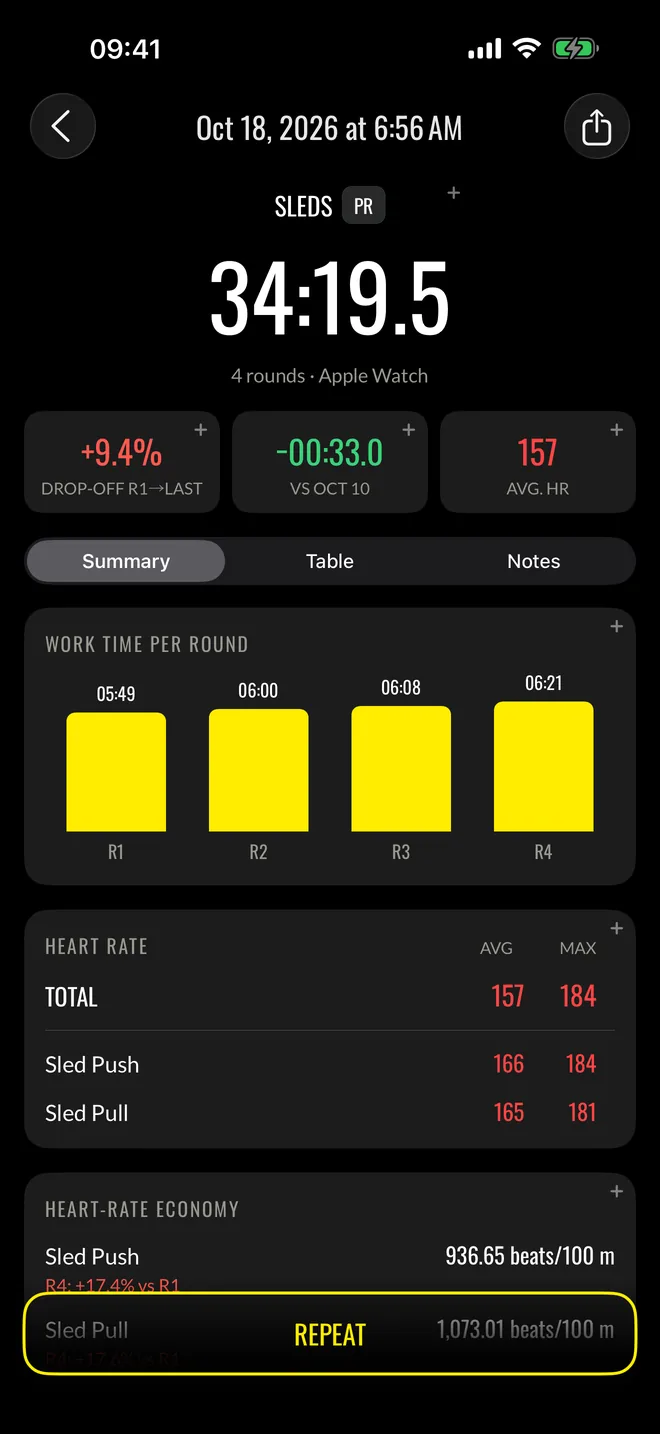
A final time hides where it was won or lost. Hybrid Flow breaks every session down by block and by round, so you can see which station drains you and when your pace starts to decay.
Heart rate is a practical, continuous marker of internal load. Relating it to the work done (heartbeats per rep, per 100 m) gives an individual economy index you can follow from session to session. These indices are training metrics, not laboratory measures of oxygen uptake.
- Drop-off from the first to the last round, block by block
- Average and maximum heart rate for every block and round
- Heartbeats per rep and per 100 m, compared with your previous session and your PRs
04 · Cadence analysis
Measure any rhythm by tapping
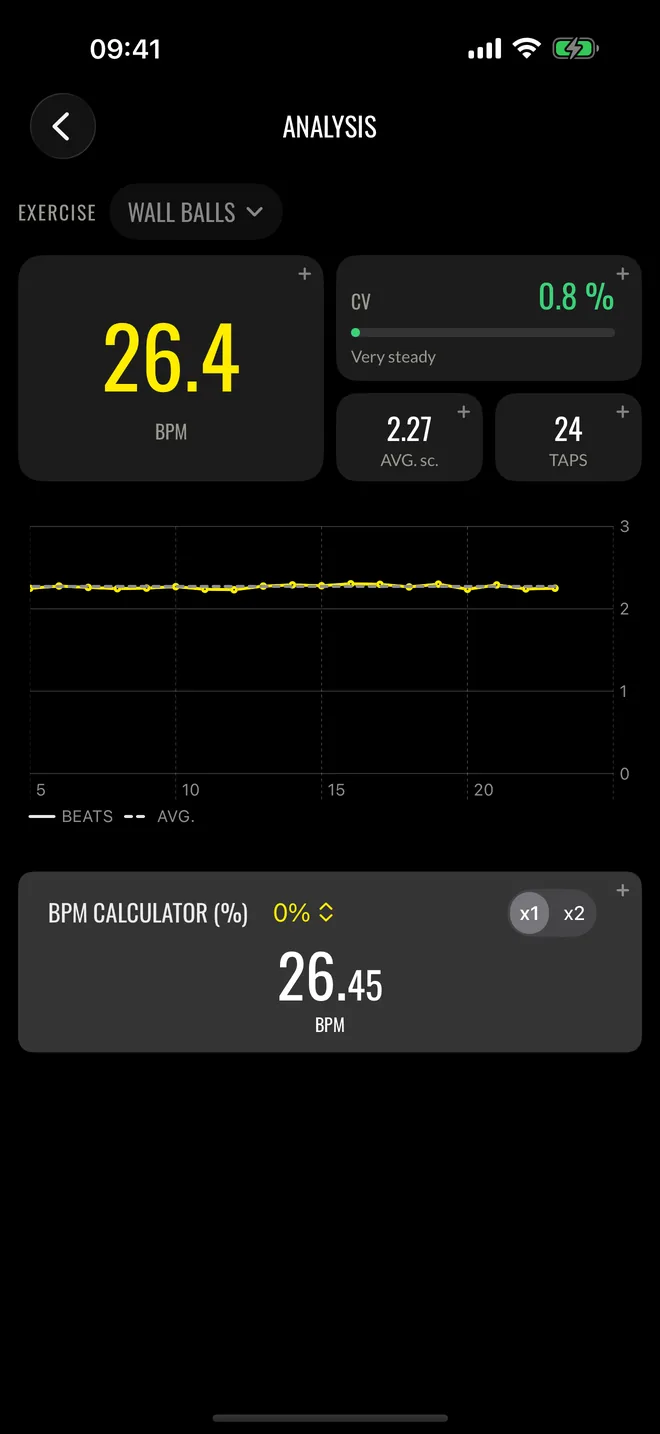
Tap along to a rower, a SkiErg, a stride or a wall-ball cycle. In seconds you get its cadence and how steady it is, and you can save it as the metronome for that exercise.
The science
Steadiness is reported as the coefficient of variation (CV) of the intervals between taps, after outliers are trimmed. It is the same statistic used to describe stride-to-stride variability.
05 · Focus audio
A 40 Hz binaural layer
Under the metronome, Hybrid Flow can play a soft binaural tone: 440 Hz in the left ear and 480 Hz in the right. The brain perceives the 40 Hz difference as a beat, in the gamma band associated with attention.
Meta-analyses report small-to-moderate effects of binaural beats on attention and anxiety, with heterogeneous results. Evidence that they entrain brain oscillations is inconsistent. We offer the layer as an optional focus aid, on by default and off in one tap. We do not claim it improves performance.
- Use headphones: each ear needs its own tone
06 · Apple Watch
The whole workout on your wrist
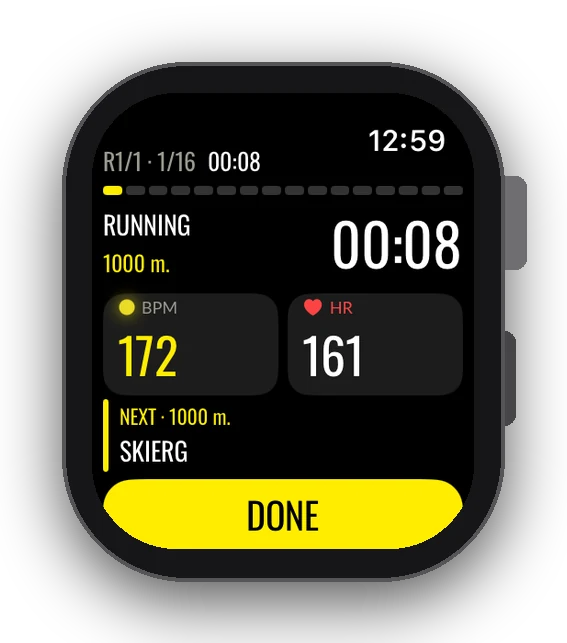
Run the complete session from the Apple Watch, cadence test included: metronome, exercises, rounds, countdowns and heart rate. Results reach your iPhone on their own. Or keep the iPhone as your screen and stream heart rate from the Watch or any Bluetooth chest strap.
The science15
Optical wrist sensors are accurate in steady work and less so during intense arm movement. For station work, a chest strap remains the reference. Hybrid Flow works with both.
- Any standard Bluetooth heart-rate strap: Polar, Garmin, Wahoo, Coros…
- Workouts saved in Apple Health
Who it is for
Built for people who read the data
Athletes
Train at a rhythm that suits your physiology, not a generic number, and see round by round whether it holds.
Coaches
Prescribe a cadence per station, then review heart rate, drop-off and economy per block after every session.
Sports scientists
Transparent methods: steady-state windows, a drift-cancelling protocol and every formula documented on this page.
Transparent methods
What we measure, and how
Cadence
Repetitions per minute (steps, strokes or reps), set by the metronome or measured by tapping.
Consistency (CV)
The standard deviation of the intervals between taps divided by their mean, after trimming outliers. Lower is steadier.
Steady-state heart rate
The mean heart rate over the last 30 s of a test stage, or over its second half for stages shorter than a minute.
Optimal cadence and zone
The cadence with the lowest steady-state heart rate at a fixed load. The zone adds neighbouring cadences within 2 bpm.
Cardiac drift
In a pyramid, the mean difference in heart rate at the same cadence between the later and the earlier leg.
Heartbeats per rep
Heart rate divided by cadence: how many heartbeats each step or stroke costs. It decides the optimum when the load isn't fixed.
Heartbeats per 100 m
Heartbeats spent per 100 m of a distance block: average heart rate × time ÷ distance.
Drop-off
The change in a block's time from the first to the last round, in %. Positive means slower.
Everywhere
On all your devices
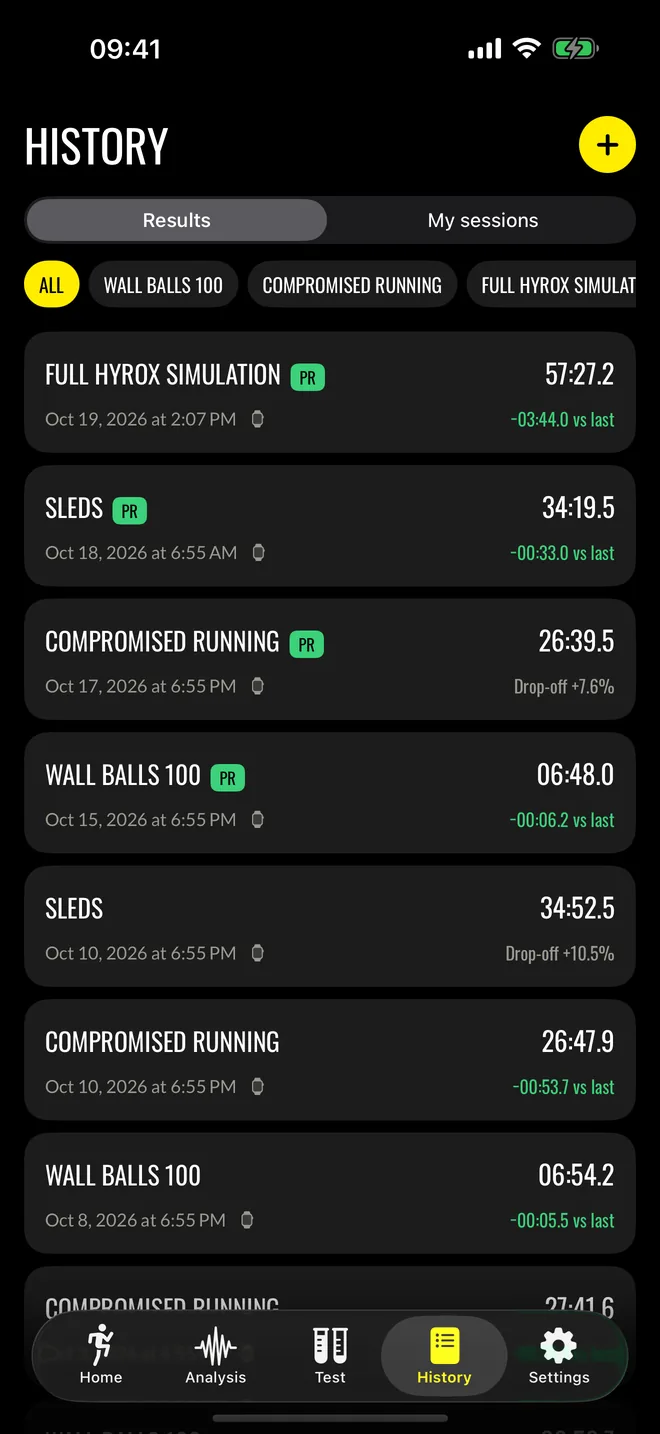
Sessions, results, analyses and tests sync through your own private iCloud database across iPhone and iPad. There is no account to create, and nobody else can see your data. Available in 7 languages.
Start free. Go Pro when you're ready.
Free
€0
- Unlimited cadence analyses
- 1 saved session
- 30 days of history
Pro
Monthly, annual or lifetime
- Unlimited sessions and every HYROX template
- Full history, drop-off and comparisons
- Live heart rate and heart-rate economy
- Incremental cadence test
- Apple Watch app
The annual plan includes a one-week free trial.
Questions
Is the method scientifically validated?
The principles are well studied: auditory-motor synchronisation, the relation between cadence and economy, and heart rate as a marker of load. The references are listed below. Hybrid Flow's own indices, such as heartbeats per 100 m, are training metrics for tracking your progress, not validated laboratory measures.
Why not just run at 180 steps per minute?
Because the most economical cadence is individual and depends on speed, leg length, experience and fatigue. The cadence test finds yours instead of assuming a number.
Do I need an Apple Watch or a chest strap?
No. The iPhone runs every session on its own. An Apple Watch or a Bluetooth chest strap adds live heart rate, which the cadence test and the economy metrics need.
How accurate is wrist heart rate?
Good in steady efforts, less reliable during intense arm work such as wall balls or sleds. For tests and station work we recommend a chest strap.
Do binaural beats improve performance?
There is no solid evidence that they do. Research on attention and anxiety shows small, mixed effects. The 40 Hz layer is an optional focus aid you can turn off in Settings.
Is it only for HYROX?
No. It works for any session built from blocks: ergs, runs, functional fitness, DEKA or your own intervals. The HYROX templates are a head start.
Where is my data stored?
On your device and in your own private iCloud database. We can't see it. Workouts are also saved in Apple Health if you allow it.
References
The research behind it
- Bood RJ, Nijssen M, van der Kamp J, Roerdink M (2013). The power of auditory-motor synchronization in sports: enhancing running performance by coupling cadence with the right beats. PLoS ONE 8(8): e70758. doi:10.1371/journal.pone.0070758
- Van Dyck E, Moens B, Buhmann J, et al. (2015). Spontaneous entrainment of running cadence to music tempo. Sports Medicine – Open 1: 15. doi:10.1186/s40798-015-0025-9
- Terry PC, Karageorghis CI, Curran ML, Martin OV, Parsons-Smith RL (2020). Effects of music in exercise and sport: a meta-analytic review. Psychological Bulletin 146(2): 91–117. doi:10.1037/bul0000216
- Hoffmann CP, Torregrosa G, Bardy BG (2012). Sound stabilizes locomotor-respiratory coupling and reduces energy cost. PLoS ONE 7(9): e45206. doi:10.1371/journal.pone.0045206
- Heiderscheit BC, Chumanov ES, Michalski MP, Wille CM, Ryan MB (2011). Effects of step rate manipulation on joint mechanics during running. Medicine & Science in Sports & Exercise 43(2): 296–302. doi:10.1249/MSS.0b013e3181ebedf4
- de Ruiter CJ, Verdijk PWL, Werker W, Zuidema MJ, de Haan A (2014). Stride frequency in relation to oxygen consumption in experienced and novice runners. European Journal of Sport Science 14(3): 251–258. doi:10.1080/17461391.2013.783627
- Moore IS (2016). Is there an economical running technique? A review of modifiable biomechanical factors affecting running economy. Sports Medicine 46(6): 793–807. doi:10.1007/s40279-016-0474-4
- Hunter I, Smith GA (2007). Preferred and optimal stride frequency, stiffness and economy: changes with fatigue during a 1-h high-intensity run. European Journal of Applied Physiology 100: 653–661. doi:10.1007/s00421-007-0456-1
- Coyle EF, González-Alonso J (2001). Cardiovascular drift during prolonged exercise: new perspectives. Exercise and Sport Sciences Reviews 29(2): 88–92. doi:10.1097/00003677-200104000-00009
- Achten J, Jeukendrup AE (2003). Heart rate monitoring: applications and limitations. Sports Medicine 33(7): 517–538. doi:10.2165/00007256-200333070-00004
- Buchheit M (2014). Monitoring training status with HR measures: do all roads lead to Rome? Frontiers in Physiology 5: 73. doi:10.3389/fphys.2014.00073
- Brandt T, Ebel C, Lebahn C, Schmidt A (2025). Acute physiological responses and performance determinants in Hyrox© – a new running-focused high intensity functional fitness trend. Frontiers in Physiology 16. doi:10.3389/fphys.2025.1519240
- Garcia-Argibay M, Santed MA, Reales JM (2019). Efficacy of binaural auditory beats in cognition, anxiety, and pain perception: a meta-analysis. Psychological Research 83(2): 357–372. doi:10.1007/s00426-018-1066-8
- Ingendoh RM, Posny ES, Heine A (2023). Binaural beats to entrain the brain? A systematic review of the effects of binaural beat stimulation on brain oscillatory activity, and the implications for psychological research and intervention. PLoS ONE 18(5): e0286023. doi:10.1371/journal.pone.0286023
- Gillinov S, Etiwy M, Wang R, et al. (2017). Variable accuracy of wearable heart rate monitors during aerobic exercise. Medicine & Science in Sports & Exercise 49(8): 1697–1703. doi:10.1249/MSS.0000000000001284
What we don't claim
Hybrid Flow doesn't promise a faster time or a higher VO₂max, and it doesn't prescribe one right cadence for everyone. It applies well-studied principles of auditory-motor synchronisation and heart-rate monitoring, and gives you your own data to judge what works. It is a training tool, not a medical device.
Hold your pace when it hurts.